

Fields of glory
Dismissed as just another also-ran in the school race, I came up with a plan.

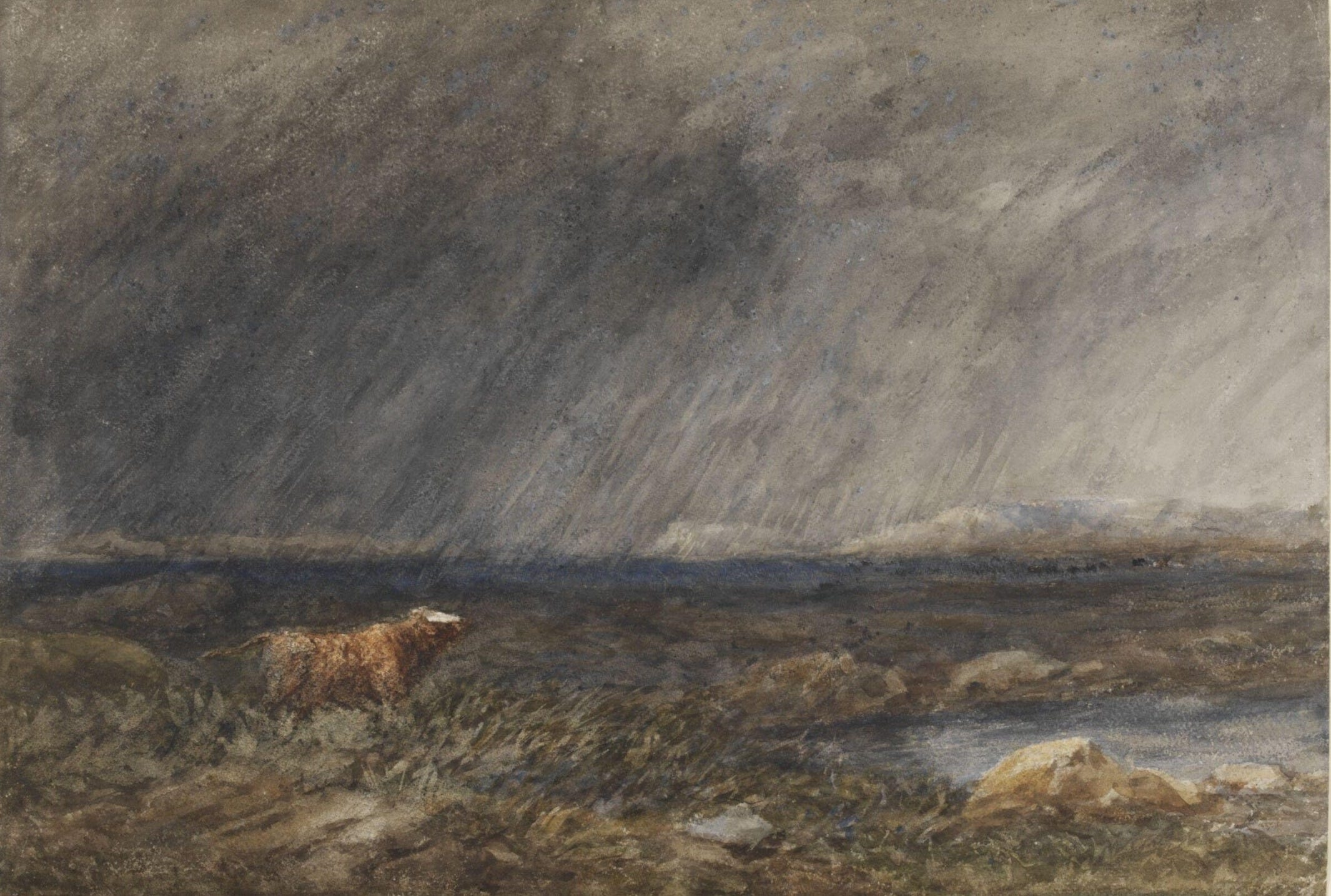
The month of the drowned dog. After long rain the land
Was sodden as the bed of an ancient lake,
Treed with iron and bird less. In the sunk lane
The ditch – a seep silent all summer –Made brown foam with a big voice
Ted Hughes’ poem, November, quoted from above, sums up very well for me the late autumn and winter in Devon, my home county. 1
The farm I grew up on is about 20 miles as the crow flies from where Hughes lived for the latter part of his life. He moved to the North Tawton area in 1961, a year before I was born.
The crow flying that way would know nothing of our poets or poetry but would recognise the ploughed fields and foaming ditches and maybe even figures of thinly clad human adolescents picking their way through waterlogged fields at just above walking pace.
One of those figures could have been me early in 1977. We were running slightly to the east of that crow’s flightpath in similarly bleak terrain and weather, struggling over the wet farmland “shining/Like hammered lead” that Hughes describes in the poem.
*
The rural world I grew up in was shared by many of my schoolmates – family farms where everybody pitched in and there was little time for leisure. This was not the countryside of quiet ease that is encapsulated in the famous Japanese proverb: “working in the field in fine weather and reading at home in rainy weather”. This suggests a way of living in quiet retirement, dividing time between work and intellectual pursuits. 2
The farmers I knew would have scoffed at such a notion. They had to work in all weathers. But something closer to the experience we knew on the farm comes from an unlikely source, the first poem in one of Japan’s most celebrated ancient compendiums of poetry, the 小倉百人一首, Ogura Hyakunin Isshu (One Hundred Poets, One Poem Each). This is the very first poem, traditionally ascribed to Emperor Tenji, and dates to the 7th century CE 3 :
Coarse the rush-mat roof
Sheltering the harvest-hut
Of the autumn rice-field;
And my sleeves are growing wet
With the moisture dripping through.
*
Every year for decades, the lower year groups of my secondary school would compete in something called the “Tiverton Grammar School Inter Cross Country Run”. But no one called it that. It was known as the Velvaines Run. I think Velvaines was the name of the farm whose owner kindly let the school use his fields for this annual cross-country race.
I wasn’t built for long-distance running or for sprinting. On the rugby field, however, on which I’d spend many hours under steel-coloured skies, I was capable of a kind of doggedness, the kind that kept me battling from one scrum (scrimmage) to another without grace or speed. I was effective, but no star player. A workhorse, you’d perhaps call me.
*
The run, for which some cursory preparation had been carried out in previous PE lessons, was not a glamorous event. It was an annual slog every year on a Wednesday afternoon, usually through driving rain, gleefully encountering land as it flew in from the eastern Atlantic.
And through mud. Wholesome thick Devon mud that oozed through the thin turf of the rough fields we ran through.
There were a couple of talented cross-country runners in the field of contestants, the best of whom was, like me, a farmer’s son. He was shorter than me, lighter and built like a natural athlete. He would cover the ground on the rugby field in a way that was gazelle-like compared to my carthorse’s trudge. For those who gave it a thought, he was the favourite to win the race.
My role in the race, like those of almost everybody, was to be an also-ran. I’d run in this race before, comfortably finishing without fanfare well down the list. Nobody, including myself, had any reason to expect anything different this year.
But something in me stirred, and I summoned the mental energy to formulate a plan. It wasn’t a sophisticated strategy like the elaborate battle plans of Caesar’s Gallic Wars, which I was reading in stuttering fashion in my Latin classes that year.
It was just this: To keep the favourite in view for the whole race, or as long as my ungainly legs would allow. I’d stick to him if I could, like the Devon clay which I used to slog through on my father’s farm. And then, well, I’d see what happened. Not exactly a strategy worthy of Clausewitz or Sun Tzu.
As we stood in the pouring rain at the start of the race, the atmosphere was one of resignation to our damp fate. There was little ceremony. In fact, there wasn’t even a starter’s pistol. Just a gruff word from one of the PE teachers, and we were off. Smartwatches hadn’t been invented, and I don’t think any of the teachers bothered to carry a stopwatch.
After all, ours wasn’t a race against time. It was a battle against the gleaming, waterlogged fields of Devon.
*
A week before, I’d played in a game of rugby against Plymouth College, a well-known private school in Devon, celebrated in those days for its prowess on the rugby field. This was a fixture that was no doubt seen by them as an automatic “W” in the season schedule.
That day, though, our team, many of whom were farmers’ sons, played the game of our lives. I remember how I enjoyed that day in my boyish way, tackling opponents until my body was almost numb from the cold and the repeated contact. And so it was that against the odds on a bleak winter’s day in an otherwise disappointing season, we won a narrow and rare victory over the much-fancied opposition.
*
As the race along the Velvaines Run entered its final third, I found myself in second place. The rain continued to fall, my legs were stockinged with dark mud, and my skimpy white PE vest was splattered with wet soil.
The field of runners was gently thinning like a flock of snipe scattering in the rain. Some of my classmates were probably walking a mile or so behind me. In front of me there was the favourite, who continued to skim across the sodden grass and muddy pools about a hundred yards ahead. The rain tasted of loam as it streamed down my face.
*
This was to be the last Velvaines Run. My school, the grammar school, was merging later that year with another school, Heathcote’s, to form a comprehensive school. The race winner this year would be the last in a line stretching back decades, though this was no storied history, more of a grudging tradition.
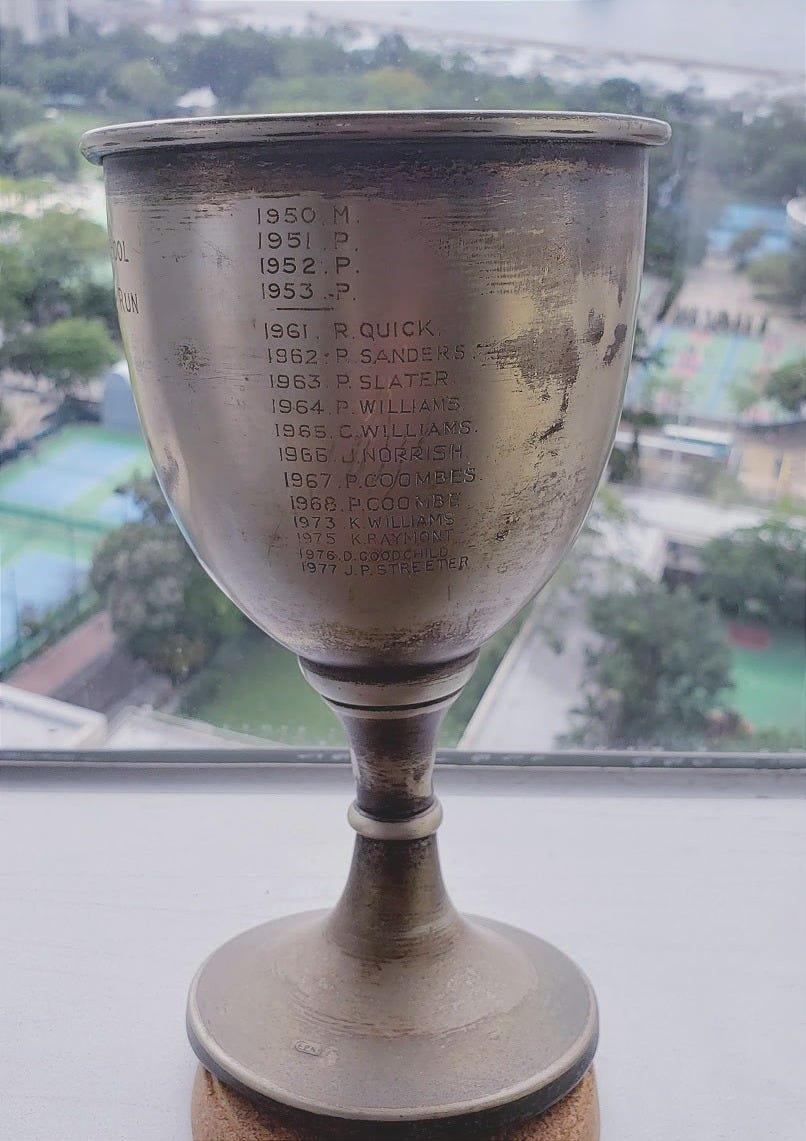
But the winner’s name would be the last to be engraved on the battered pewter trophy, which had been donated in 1949. Perhaps it was this thought that kept me labouring my way across the field and which wouldn’t allow me to take my rain-filled eyes off the boy ahead of me.
*
We came to the final half mile. This closing stretch didn’t have the obliging camber or smooth surface of a stadium track but was a ploughed field laid out like a tablet of deep and sticky chocolate before us. It was heavy going for my tired legs, and I wanted to give up the chase.
But somehow I conjured up a fighting spirit. The Roman poet Lucan said that “Caesar, impetuous in everything,
“Thought nothing done while anything was left to do. 4
And something in me said, ‘If I give up now, I’ll have achieved nothing.’ I battled on.
I began to sense that my ungraceful furrowing was better suited to the deep mud than my opponent’s nimble gait. I found the strength, or perhaps just the obstinacy, to forge onwards with increased urgency. I began possibly the slowest sprints in the history of running, almost in slow motion, with my feet shifting shovelfuls of dark Devon mud as they inelegantly lifted and fell.
But it worked.
Peering through what was now just heavy drizzle, I could see my opponent visibly slowing in the sodden earth. This encouraged me to a last spurt of energy. As I wordlessly passed my opponent, a few yards to my left, I had no thought of what his reaction might be and no energy to look. I had just one focus, which was the finishing line.
The teachers and few parents who stood at that line greeted me with surprised looks rather than cheers. My opponent, their favourite to win the race, struggled home a good hundred yards behind me.
I’d won.
*
Apart from the trophy, or cup, as we called it, my “prize” for this unlikely victory was to represent the school in a race between schools in the country. That event was to take place a few weeks later, so I had little time to enjoy my moment of triumph. I was supposed to get myself in shape for that more competitive run.
The day of the county race was dry but raw, and the course was over flinty soils around a forest. This was a different part of the county, unfamiliar territory, without a ploughed field or foaming ditch in sight.
The other runners all looked built for speed and stamina, and some carried insignia of running clubs and wore expensive-looking running shoes. I trudged to the starting line in my standard-issue PE kit with trepidation. My “prize” was starting to feel like a punishment.
The race seemed like an extended sprint around and over wooded hills. I quickly dropped behind the leaders. I kept running as fast as my laboured style would allow, but I finished the race just a few positions up from last and was dry retching from the effort as I passed the finish line unnoticed.
Thus, my days as a long-distance racer were over almost as soon as they began. Winning the Velvaines Run was to be a one-off.
*
In 1896, the poet and classicist AE Housman wrote in To an Athlete Dying Young, 5
Smart lad, to slip betimes away
From fields where glory does not stay,
And early though the laurel grows
It withers quicker than the rose.
And indeed, the laurels I earned that day in the mud soon withered, and the glory did not stay.
But at least, I consoled myself, I got to keep the cup.
The poem was first published a year before he settled in Devon in Lupercal (1960), Faber & Faber.
It’s a yojijukugo, or four-character proverb in Japanese: 晴 = sunny. 耕 = ploughing. 雨 = rainy. 読 = reading.
In Latin, this was “Nil actum reputans si quid superesset agendum.” The quote is from Lucan’s poem on the Roman civil war, Pharsalia, Book II, a work left unfinished at his death. Emperor Nero forbade publication of Lucan’s work after they fell out, though some books remained in circulation.
George Orwell described Housman’s hugely popular collection, A Shropshire Lad, from which this poem comes, as characterised by “bitter, defiant paganism, a conviction that life is short and the gods are against you, which exactly fitted the prevailing mood of the young.”
Well done, Jeffrey, a moment of glory – albeit short – is still glory. And you told it even more gloriously.
A lovely story, beautifully told. A good old English underdog result.