

Miracles of delight
In pursuit of the Japanese primrose

Not every journey is a pilgrimage. Not every search is a quest.
But spring has arrived in full bloom here in the northern hemisphere, and that is the time when the characters in Chaucer’s Canterbury Tales set off to visit a holy site in the east of England:
Whan that Aprille with his shoures soote,
The droghte of March hath perced to the roote,
And bathed every veyne in swich licóur
Of which vertú engendred is the flour;
Whan Zephirus eek with his swete breeth
Inspired hath in every holt and heeth
Thanne longen folk to goon on pilgrimages,
And palmeres for to seken straunge strondes,
To ferne halwes, kowthe in sondry londes;
Geoffrey Chaucer, the Prologue to The Canterbury Tales (written between 1387 and 1400).
In modern English: 1
When that April with his showers sweet
The drought of March has pierced root deep,
And bathed each vein with liquor of such power
That engendered from it is the flower,
When Zephyrus too with his gentle strife,
To every field and wood, has brought new life
Then people long to go on pilgrimage,
And palmers who seek out foreign strands,
To far-off shrines, renowned in sundry lands.
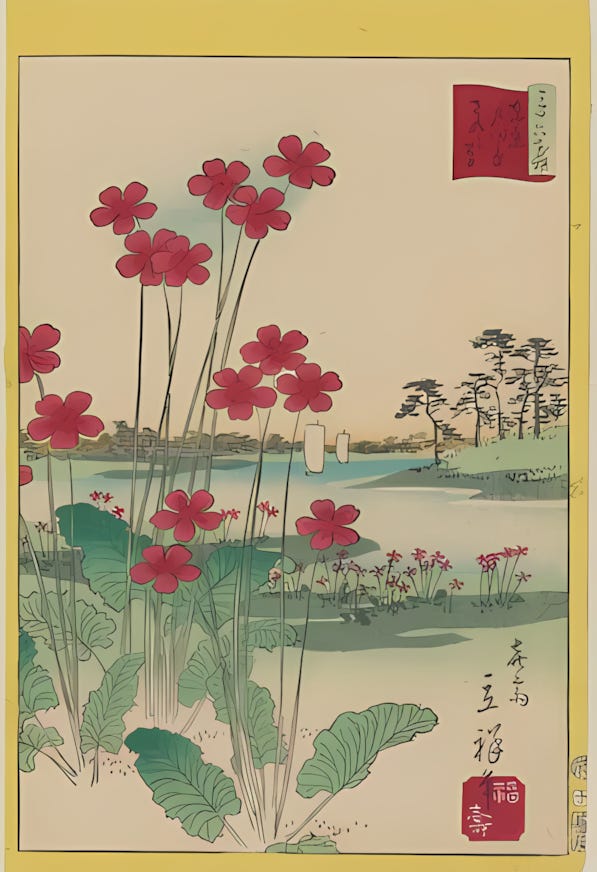
And this spring I have found myself setting out in search of something. In my case, it was a flower – the humble Japanese primrose (Primula sieboldii).
Here it’s known as the サクラソウ or ‘sakurasō’. The name is usually written in katakana, as above, but its Chinese characters add something to its attraction. 桜草 literally means “cherry-blossom grass” or “cherry-blossom plant”.
Unlike Chaucer’s assorted group of travellers, I have never thought of myself as a pilgrim. Even as a tourist I usually travel without much direction. I guess you’d say I’m an aimless rambler.
But this was a flower I had to track down.
*
I recently wrote of the AI man arriving in a blaze of speed down the lane of the Devon farm where I grew up in the 1960s. The tarmacked track was banked by solid hedgerows, and at the lower end near the farmhouse was a grassy bank where effervescent yellow was refracted through the bright dew of morning. The source of this enchanting light was the primroses (Primula vulgaris).
I was reminded of this sight when I recently came across Tom Disch’s poem, “Memories of a Primrose”, which begins,
Always the mornings
were miracles of delight
The English word “primrose” seems to derive from “prima rosa”, literally the first rose of the year. They were true harbingers of spring, and even my childish self recognised their special beauty. And I know they also meant a lot to my mother.
I think it was this childhood memory of the primroses that spurred me to set off in search of ‘sakurasō’, so many years later and with a distance of many miles.
*
My haphazard research first told me of a sakurasō festival at a park near the Arakawa River. So one afternoon, I took two buses through an industrial landscape along the edge of Tokyo and eventually found myself in the park.
Skirting a lake that used to be part of the river, I soon arrived at the site of the festival. It looked rather like someone’s garden or backyard had been shifted into the park, and it was covered in flowerpots. The “festival” was little more than a collection of potted garden sakurasō, which were cultivated by local enthusiasts and one or two local schools.
The volunteers on duty were friendly and apparently proud of their work, though they seemed most interested in chatting to eachother. They were all dressed in rather fine, matching 法被 or “happi” jackets, which proudly displayed their affiliation to the festival.
The flowers themselves were a disappointment, however. There were some striking variations from the standard pink of Primula sieboldii, but generally the primroses did not seem to be flourishing. And while plum blossoms, like sakura, always seem to gain in effect when many are seen together, the effect here of the collected plant pots seemed to be one of diminution.
And anyway, I wasn’t really looking for a collection of potted plants. What I really wanted to see were wild primroses. The plants growing in their natural habitat were central to the story that had led me to this part of Tokyo, going back to the beginning of the Tokugawa Shogunate in Japan.
*
None other than Ieyasu Tokugawa (1543 – 1616), the first Tokugawa Shogun and one of the great unifiers of Japan, came across these plants growing in their natural habitat along the marshy flanks of the river.
He was out hunting with hawks along the Arakawa River when he saw the primroses. He was enchanted by them and ordered some plants to be taken back to Edo Castle for cultivation. 2
It’s an incongruous image: fierce Ieyasu, the warrior who united his country by force, chancing upon these flowers with delight in the wet, marshy lands along this powerful river.
But it appears that his enthusiasm for the charming and vibrant pink flower in a landscape of dark green was genuine. And it set in motion a fashion for cultivating the flower that lasted right through the Edo era and into the 21st century. 3
The flower has also caught the attention of Japanese poets. This haiku is attributed to one of the most celebrated poets of the Edo period, Kobayashi Issa (1763—1828):
我が国は
草も桜を
咲かせけり
Waga kuni wa
kusa mo sakura o
sakasekeri
In our country,
even the grasses
make cherry blossoms bloom.
*
These days with the river rerouted and tamed and with warmer weather drying up the land, the flower’s natural habitat is dwindling.
Meanwhile, the spring was progressing. Was I too late to see any wild sakurasō this year? Or indeed, were there any left to see?
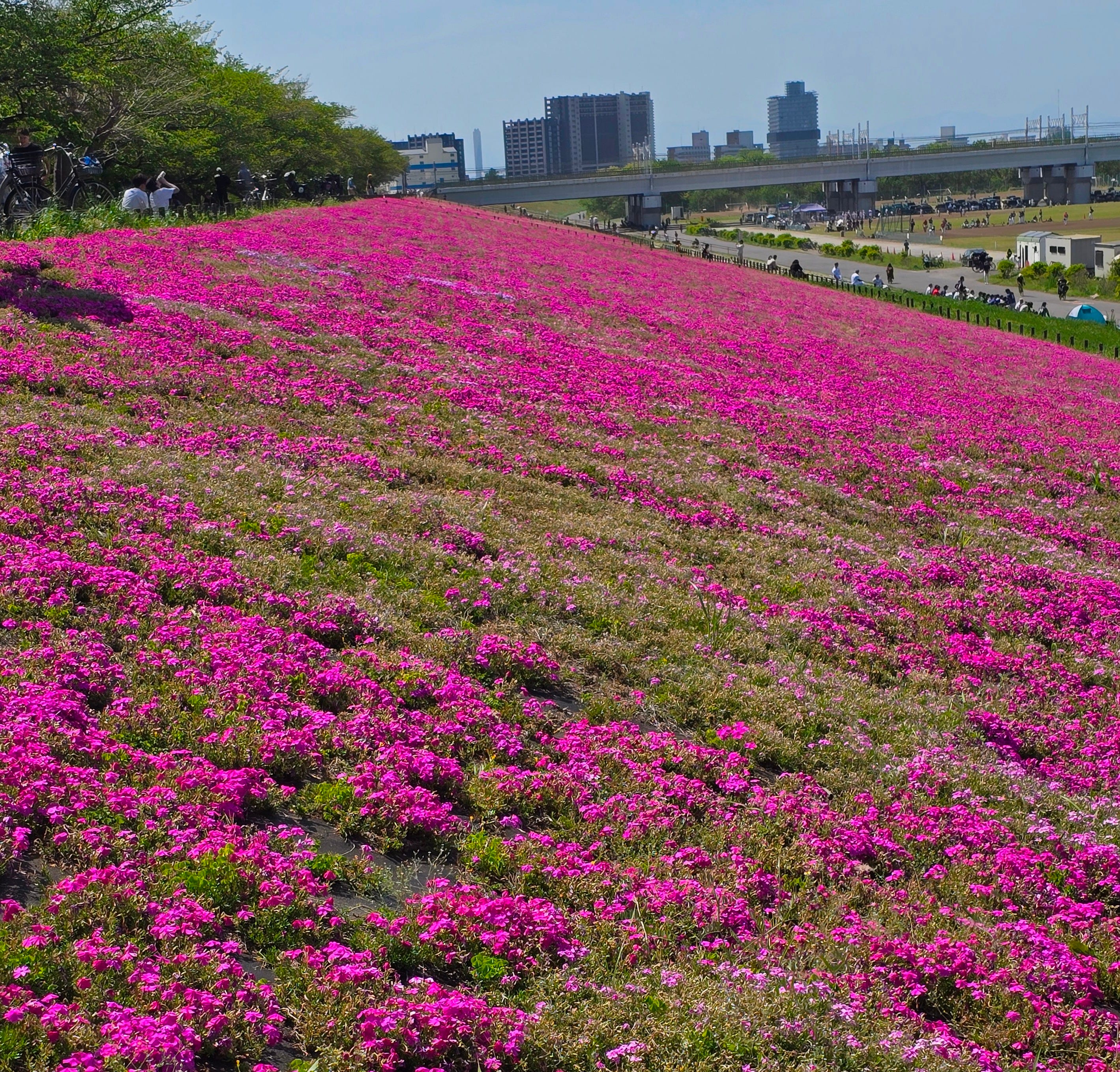
More hurried research led me to online reports of a small pink flower along the banks of the Arakawa a little further downriver. So the following Sunday I took a couple of trains to take a look for myself. It was a day of bright sunshine and heat that almost felt like the start of summer. Arriving at the river, I saw that, as so often in this area, part of the old river flood plain was given over to baseball fields, and games were in full, raucous swing. Along the banks I saw a rich carpeting of small pink flowers. Had I found the sakurasō?
Hurrying to investigate, I soon realised my mistake. These lovely flowers were not sakurasō but shibazakura (芝桜 - Phlox subulata). The Japanese name means “lawn cherry blossoms”. It’s not native to Japan but rather to North America and was introduced here during the Edo period. It creates some spectacular displays, and I enjoyed seeing it in full flower, but it was not what I was looking for.
I had only one more lead to follow. Upriver, there was, according to Google Maps, something called “Tajimagahara Sakurasō Habitat”. Perhaps I might find a wild sakurasō there?
A twenty-minute walk took me to the next station, and then two trains later I was walking again, this time for about 40 minutes, hoping to get to the park where this habitat was located before the light faded. Wandering through a landscape of pylons, flood barriers and embankments I recognised from a previous hike in the area, I was glad of my sunhat and water flask in the warm afternoon sun.
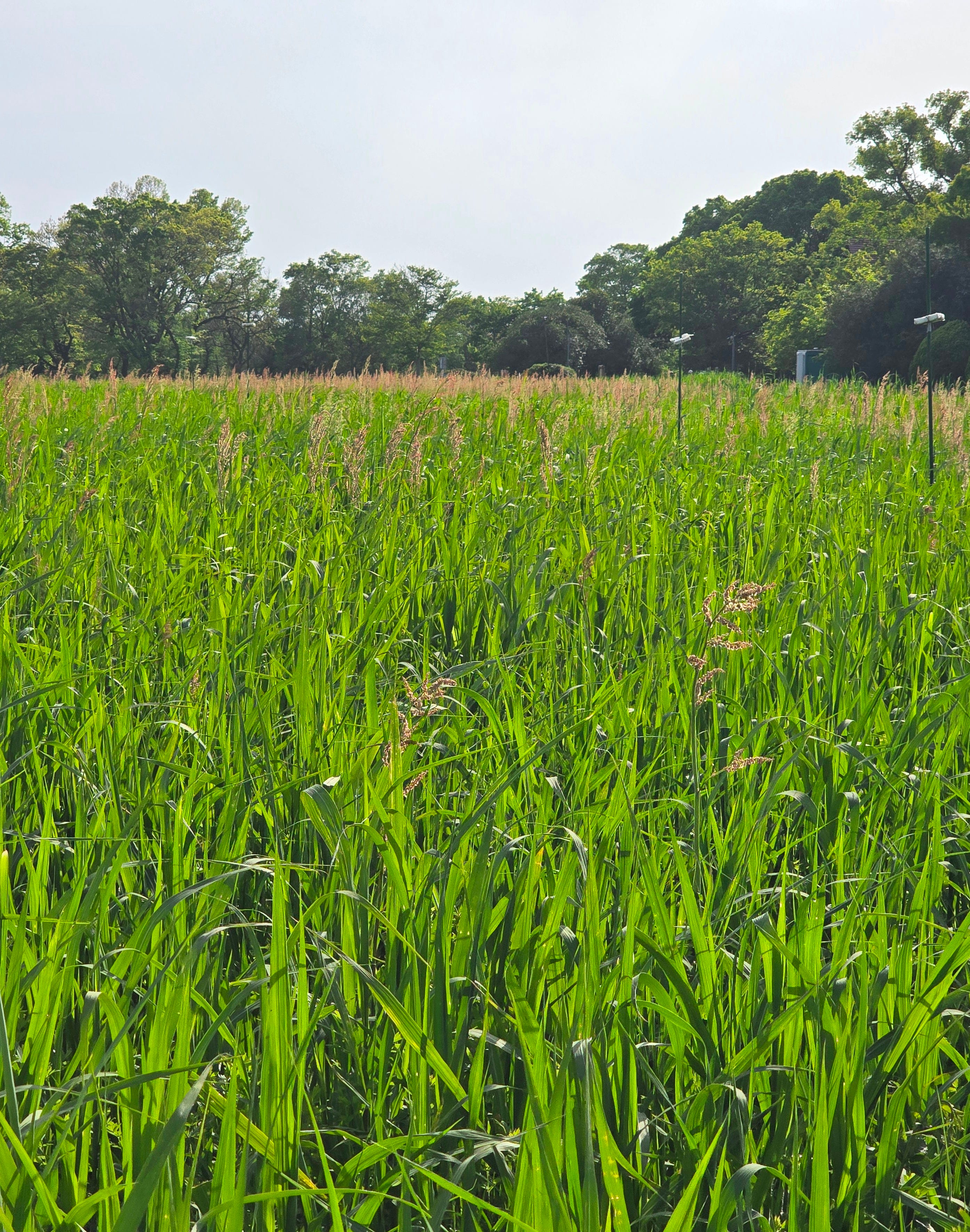
Reaching the top of a low hill, I finally saw it – an expanse of green in the distance, fenced off and signposted as Sakurasō Habitat, one of the ten Natural Monuments which had been the first designated under a new law in 1920.
As I approached, I saw signs mentioning a festival, and I could hear music in the distance. I hurried forward in expectation. As I got closer, however, I saw that the tall dark grass showed no specks of colour as I had expected. Were all the flowers gone?
And the music, though welcome, came from a brass band rehearsing in another corner of the park and from individual musicians who’d come to practise out of earshot of their neighbours’ apartments. There was no sign of a festival in progress.
I stopped in front of the fenced enclosure and peered hopefully into the grassy green depths. Nothing. Not a sign of the sakurasō either.
Tired, thirsty, and disheartened, I sat in the shade of a tree and despondently ate the snack I’d picked up at a convenience store near the station. Meanwhile, the music continued: I could hear the wistful sound of trumpets and horns through the trees at one edge of the park. A breeze sprang up – one of Chaucer’s spring zephyrs? And children were excitedly learning to ride bicycles guided by anxious fathers on the nearby paths.
And soon, despite my disappointment at not finding the flower I came to see, I felt myself relaxing, overcome not by tiredness but by calm enjoyment of the afternoon in the park. Maybe I had missed the sakurasō, but here I had found a welcome harmony, a gentle and relaxed scene that soothed away the frustrations and exertions of the day.
*
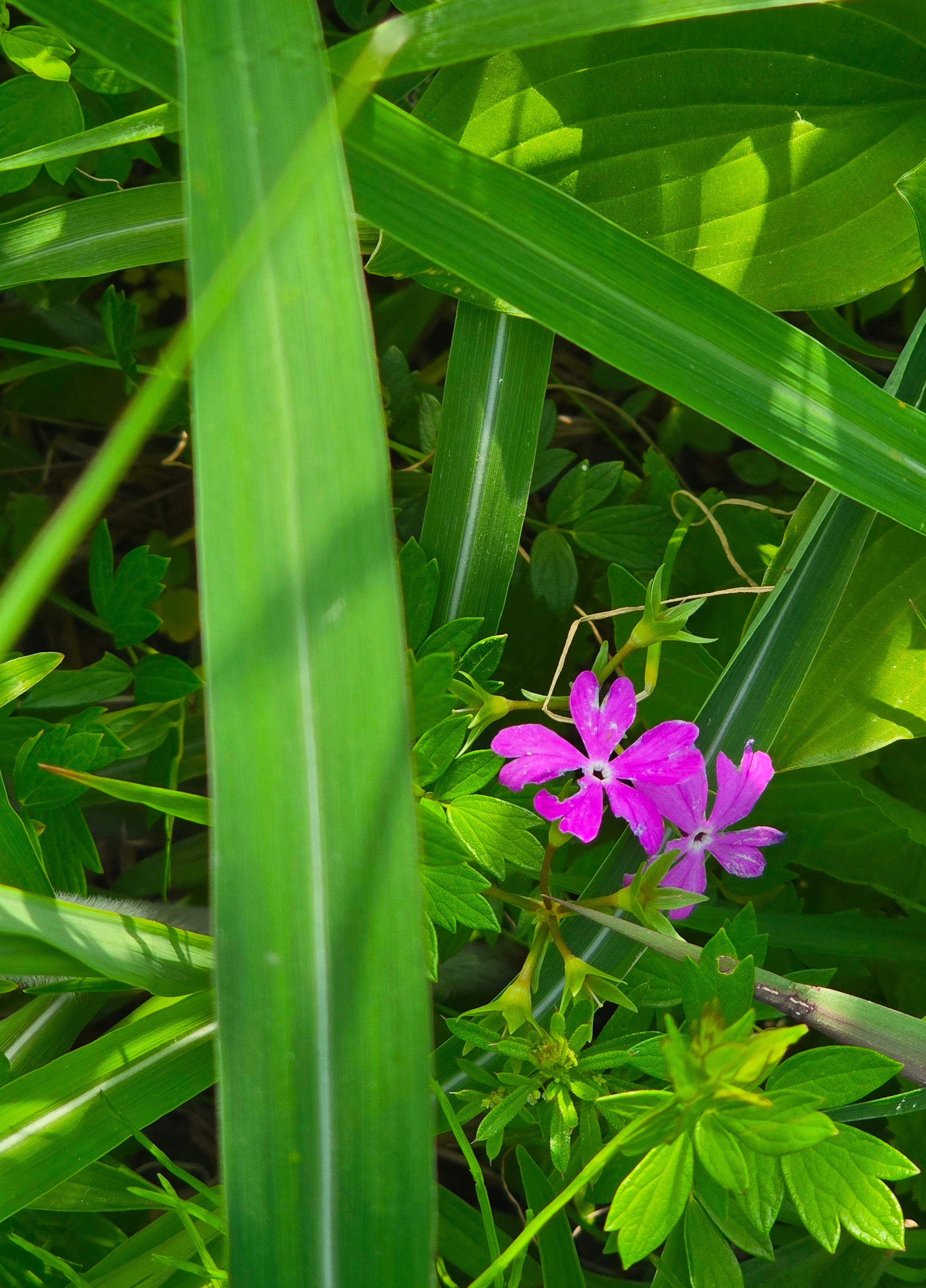
As the sun began to get lower, I set off for home, walking back past the green expanses of grass. As I did so, I noticed a man, a little older than me, with the tell-tale lanyard of a volunteer, walking along one of the paths that crossed the protected fields of green. He stopped and knelt to put something in the ground before getting up and moving on. I followed him and saw that he’d placed a simple wooden marker next to a pink flower almost entirely hidden by the long grass.
It was a sakurasō. At last I’d found one! I looked around and saw two (or perhaps it was three) others. A meagre haul for a day’s journeying, perhaps, just a few tiny pink flowers shyly huddled in a wide thicket of grass.
But the joy I felt on seeing them took me back to my days on the farm and those first twinkling lights of spring. As my spirits rose, I wondered if this was the same spot where the great Shogun had first lost his heart to the flower. I could now understand how he might have felt.
Unlike Chaucer’s motley crew of pilgrims, I hadn’t come in search of a holy site. But the sight of those tiny flowers in the fading afternoon did make this, in the words of the “Pardoner’s Tale”, its own “perfect glorious pilgrimage” and the ideal prologue to the arriving beauty of spring.
Such hunting expeditions were used also as a chance to survey the land, allowing the Shogun to get out and see how people lived and what the landscape contained.
The great military leader’s delight in the primrose reminded me of Jocelyn Brooke's hauntingly beautiful series of novels, The Orchid Trilogy (1948-50):
“The Military Orchid had taken on a kind of legendary quality, its image seemed fringed with the mysterious and exciting appurtenances of soldiering, its name was like a distant bugle-call, thrilling and rather sad, a cor au fond du bois.
The idea of a soldier, I think, had come to represent for me a whole complex of virtues which I knew that I lacked, yet wanted to possess: I was timid, a coward at games, terrified of the aggressively masculine, totemistic life of the boys at school, yet I secretly desired, above all things, to be like other people. These ideas had somehow become incarnated in Orchis militaris.”
This passage is from page 3 of The Orchid Trilogy in my Picador edition. You can read about the trilogy here. Brooke’s beautiful image of the “cor au fond du bois” seems to come from Alfred de Vigny’s poem, Le Cor (1826), which begins,
J’aime le son du Cor, le soir, au fond des bois.
“I love the sound of the horn in the evening, deep in the woods”.
.
Chaucer meets Japanese poetry. You, on your initially bootless quest, make the connection and leave its imprint. The pink flowers offered up a Wordsworth moment, all the lovelier because you were seeking something else.
What a wondrous adventure, Jeffrey. The Devon memories, the historic, literary, and cultural significance of this unicorn of a flower. The disappointment of the sad little site. That’s what you get when you try to fence in a unicorn! Finding the flower at last, placed there by a fellow primrose admirer. The journey that matters more than the prize.
I’m reminded of the time I saw a showy ladyslipper at the side of a road in a Minnesota state park. It is a magnificent pink orchid. The state flower, it’s highly protected, and rare. It typically grows in remote shaded areas. I ran back to the campsite, grabbed my entry-level Nikon, and started snapping photos. Soon I was surrounded by a crowd: amateurs, but with better cameras. I framed some of the pictures. They are a shadow of the real thing. After more than forty years, they still give me a thrill.
Thank you for another lovely post.