

The Monet Line
The experience of viewing a major exhibition is not just about the art

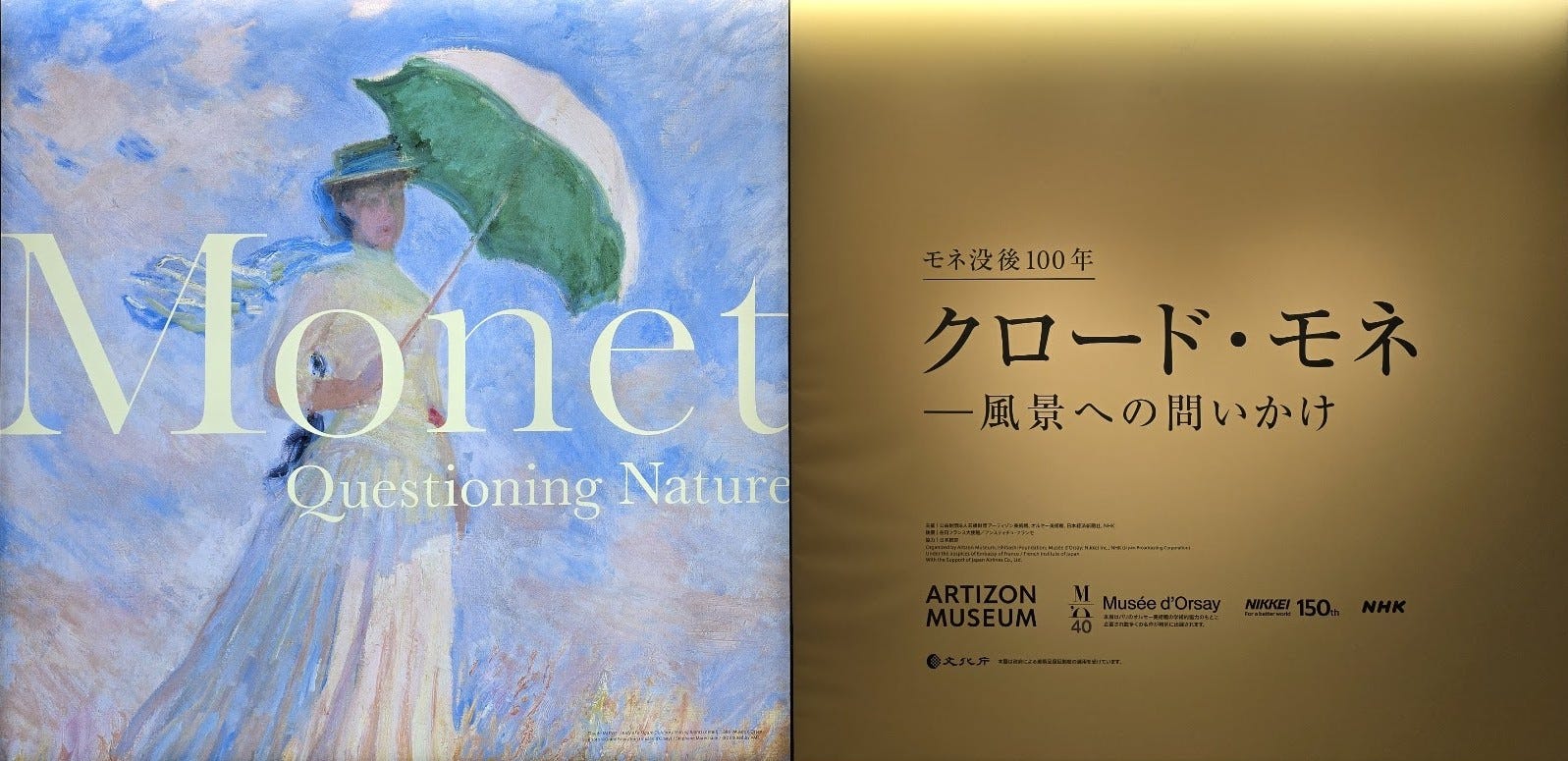
Stepping off my train on the Tokyo metro system, I made my way to the Artizon art museum, housed in a new and imposing building in Tokyo’s wealthy Kyobashi district. It’s surrounded by office blocks, hotels, and the stores of major brands.
Entrance to exhibitions there is via a lift: having booked a ticket and a timeslot, you wait your turn to be ushered into its cool steel interior to be whisked away to a distant floor.
The exhibition I was going to see was: Monet: Questioning Nature. 1 It had been some time since I’d been to a solo exhibition of the painter, and I entered the busy space with a strong sense of expectation.
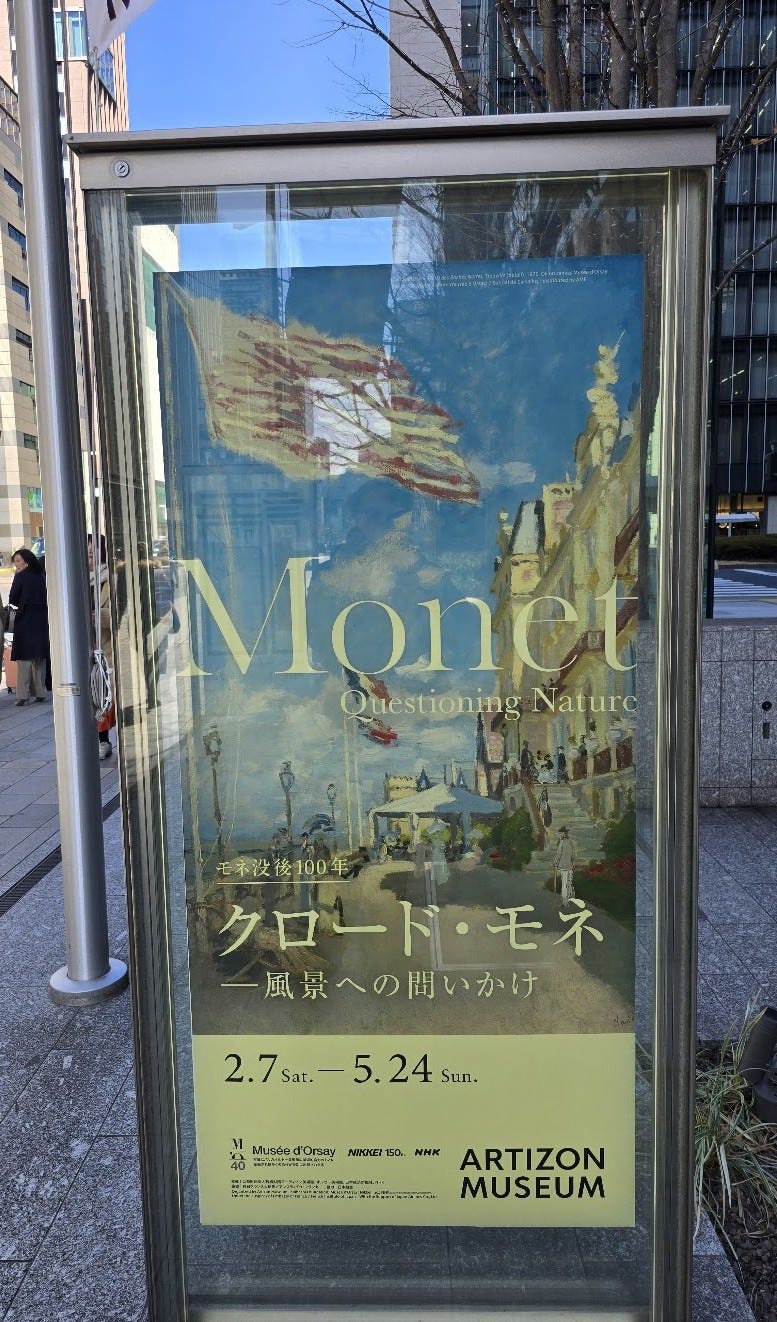
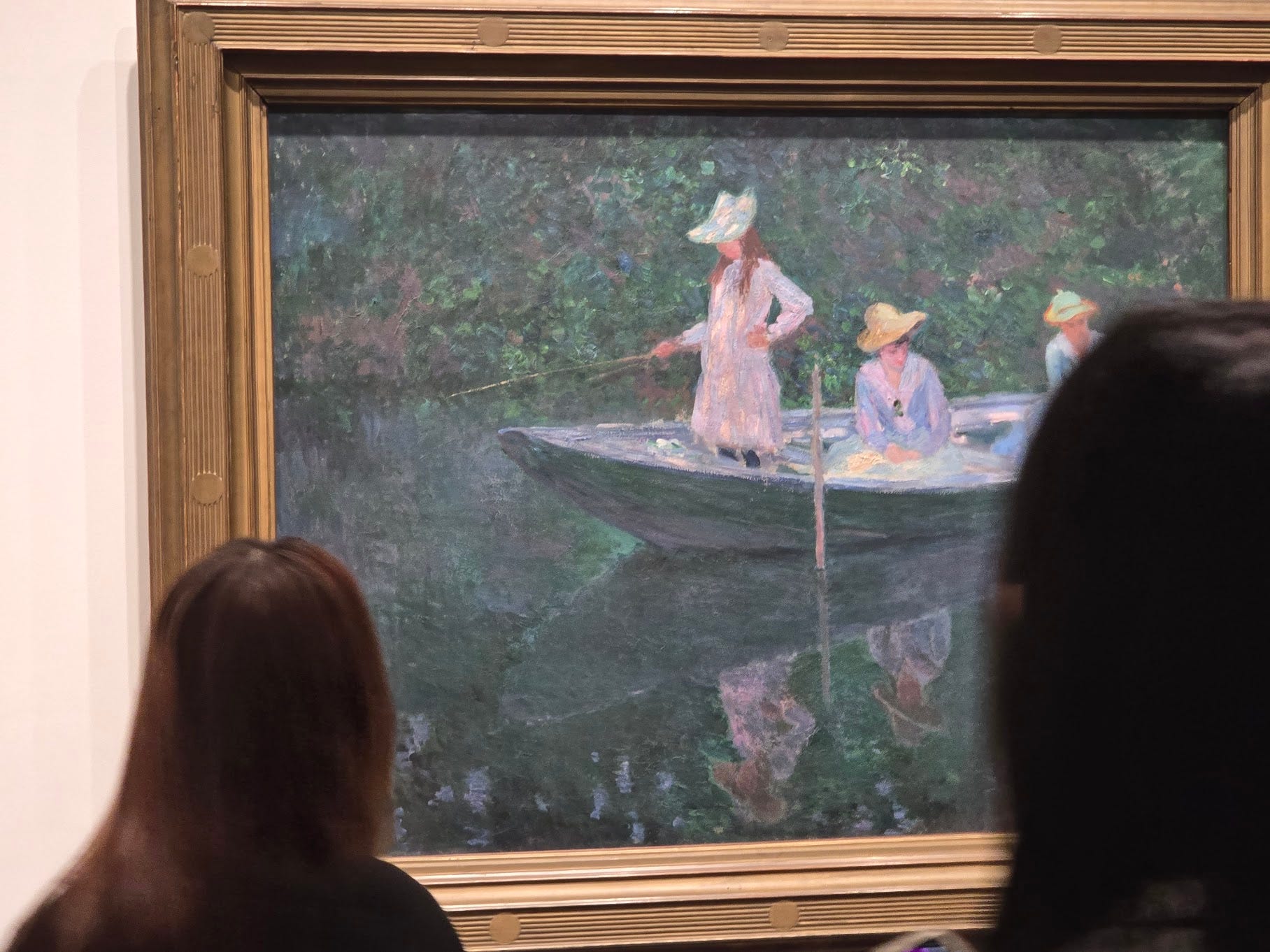
But if the lift to the start of the exhibition felt like a confinement, so did the experience of moving all in space at the same time with a group of strangers randomly thrown together. The crowds were as big a presence as the artwork.
And if there is something pleasingly communal about it, to be united in appreciation of works of art, there is also something a little inconvenient about it too, in a very big city kind of way. In fact, at times I felt I was commuting along the Monet line, with only a brief stop at each painting. There’s just enough time to focus your eyes on the canvas you’ve arrived at before the momentum of the crowd persuades you forward to the next station.
In shows like this, much of the time our view is partly obscured by fellow commuters, just as we impede their view in turn.
Monet famously wrote, late in life, “All I can say is that painting is terribly difficult.” And amidst the crowds, on the conveyor belt of devoted appreciation, even seeing it was a challenge.
But I was not surprised to see the popularity of this most accessible of artists. As novelist and essayist Julian Barnes has said, Monet’s work is possibly “the best way to introduce someone young to art – and not just modern art. This is partly because of what he didn’t paint.” 2
Certainly Barnes makes a good case for Monet’s seeming universal attraction:
He didn’t do historical or religious subjects: no need to know what is happening at the Annunciation (let alone the Assumption of the Virgin) or what Oedipus said to the Sphinx or why so many naked women are attending the death of Sardanapalus. He never painted a literary scene for which you need to know the story. None of his paintings refers to an earlier painting. He was the first great artist since the Renaissance never to paint a nude. He painted portraits but it didn’t matter (except to him) whom they were of. You don’t need to know the history of art to appreciate a Monet picture because he wasn’t much interested in the history of art himself (though he revered Watteau and Delacroix and Velázquez). He had even less interest in the science of visual perception. His art was secular and apolitical.
I wonder whether this also explains in part my muted reaction to his work. Perhaps too much was left out?
Not even his beautiful waterlilies could get my pulse racing. Perhaps I’d seen them too often and on too many T-shirts or tote bags. Perhaps we can have too much beauty. Perhaps we can grow complacent about even the best things in life.
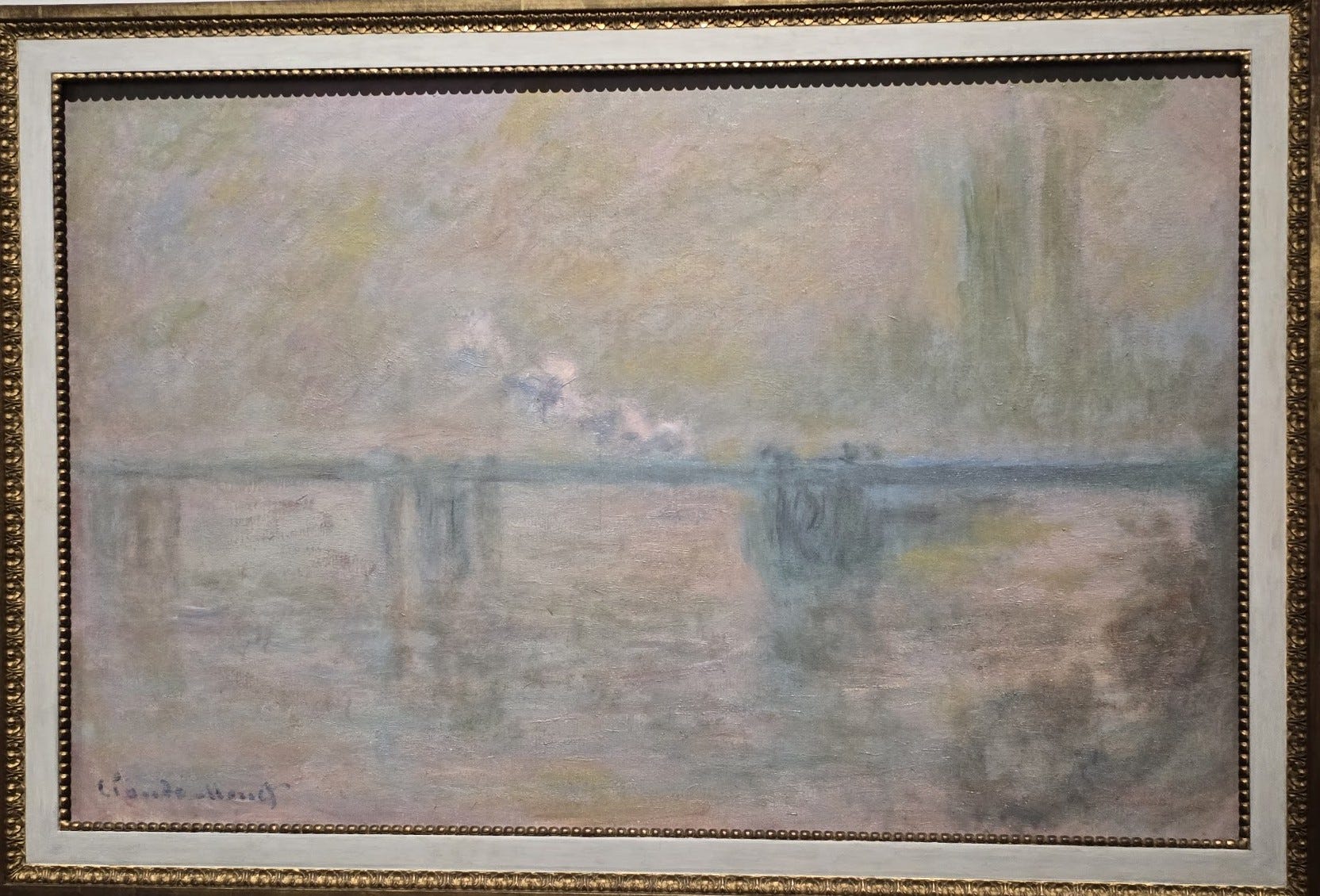
I certainly enjoyed some of Monet’s work on display – for example, the beautiful painting of the train on Charing Cross bridge or the twilight in Venice, both in this show.
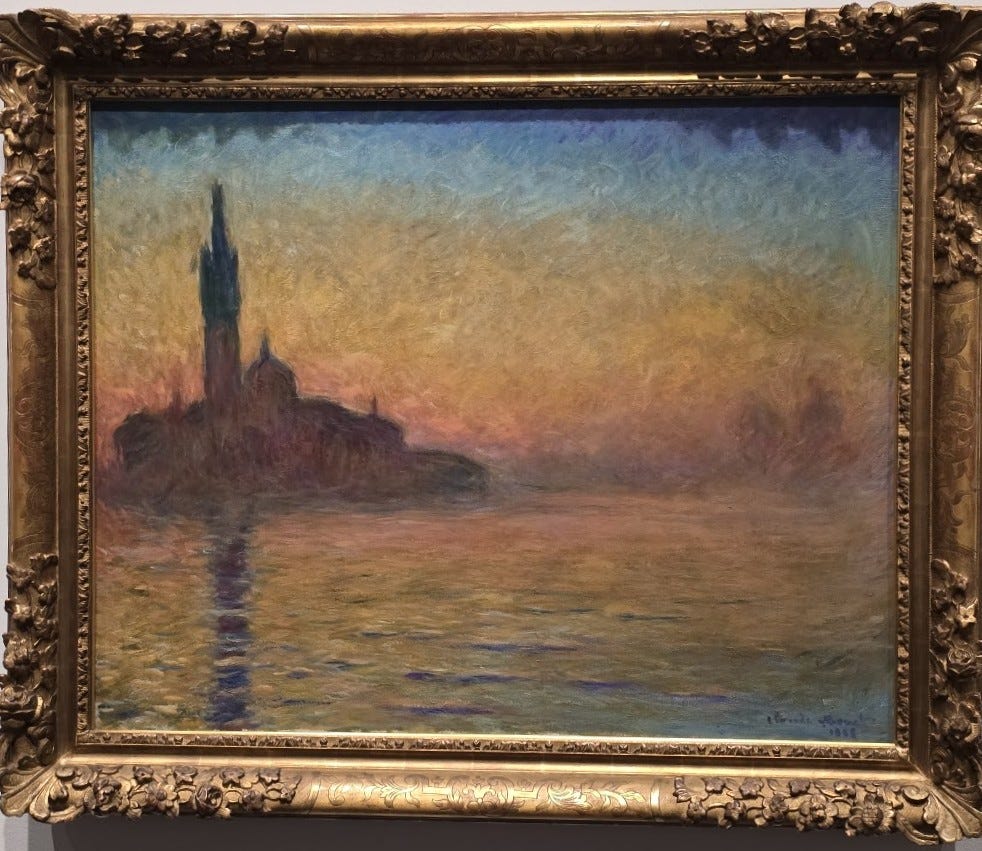
But something was missing.
When I walk around an exhibition (or watch an opera or film), I wait for “the moment” to arrive when the work grabs my attention and creates a special level of attraction and interest. It’s that aria, scene, or painting that transports you to a new level of appreciation and harmony. But in this exhibition, though I experienced an even sense of pleasure (which occasionally dipped and was sometimes marred by the cramped and crowded venue), that moment never came.
Back in the day when people were searching for genetic explanations for everything, I might have felt (or been told) I was lacking the Monet appreciation gene. But in the absence of such easy reductionism, I find it very hard to explain why this much-loved artist fails to make my pulse race.
Historically, reactions to Monet and his fellow impressionists have tended to be more animated. Reporting back to Monet on the success of the Fourth Impressionist exhibition, Gustave Caillebotte commented: ‘The public is cheerful, people have a good time with us.’ 3
And in a light-hearted response to the piece by Barnes, the renowned art critic TJ Clark wondered,
But is it cheerful à la Wodehouse, or à la Winnie in Happy Days? Or cheerful in the way of Ian Dury, listing his reasons? (‘Going on forty no electric shocks.’) I for one can never decide.
I have no idea either. In fact, I’m not sure I really find his work cheerful at all.
And to be honest, cheerfulness seemed absent from the viewers the day I was there. The atmosphere was more intense than that. Was it awe, rather? Or reverence? Or bewilderment? Or, in some cases, who knows, was it even the boredom of the commuter waiting to get to the end of the line?
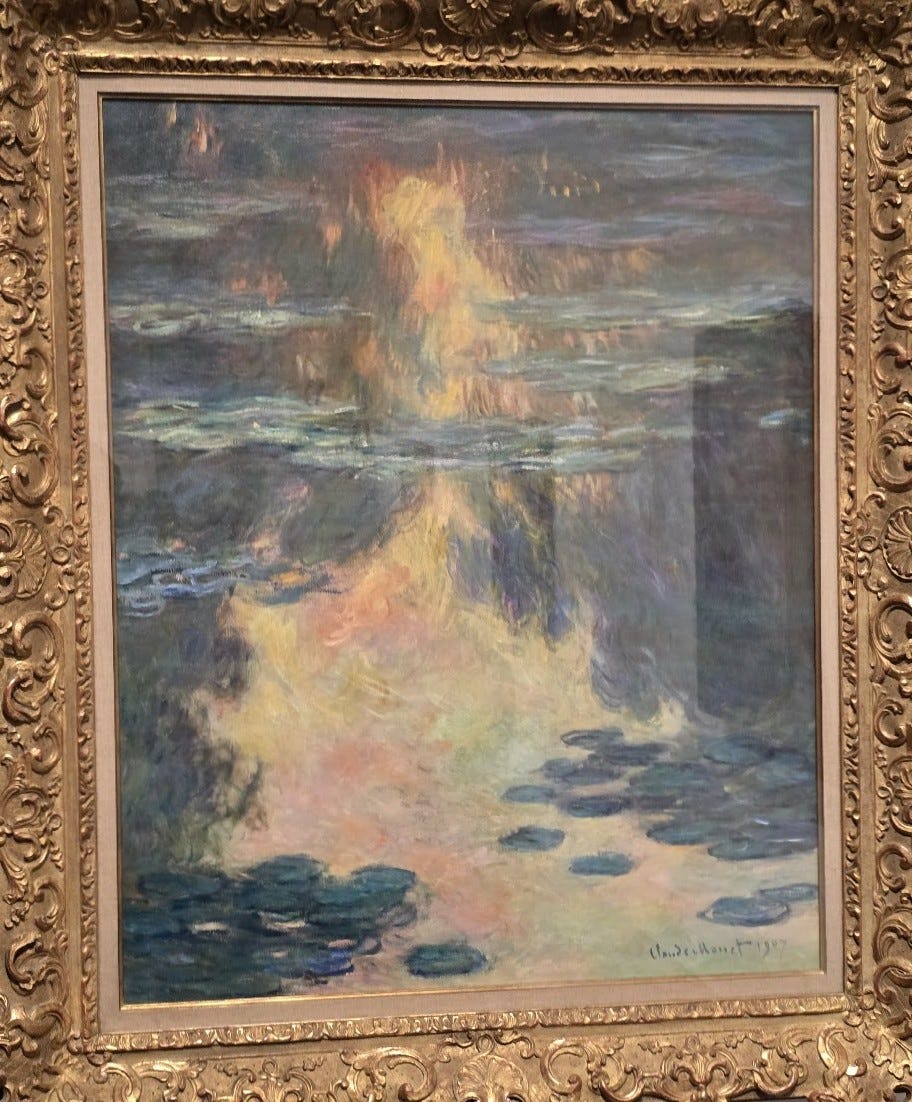
The end of the Monet Line actually seemed to arrive abruptly with the display of the museum’s own Water Lily Pond (1907), one of those works that perhaps points the way towards the abstractions of 20th-century art.
One moment I was admiring the work; the next, I was on the down escalator heading for the gift shop and its copious merchandise.
My commute was complete, but my expectations had been derailed. I’d “had the experience but missed the meaning”. Like a train scheduled for another day or running on a different line, the hoped-for moment of intense joy never arrived.
The introduction to the exhibition in English says, “In the light of our current questioning of nature and ecology, the exhibition will show how Monet himself was confronted with the profound upheavals in the landscape and how he was affected by them.” If I’m honest, I’m not sure I understand either the question we are asking or the answer Monet gave.
You can read his essay here. The London Review of Books has a paywall but often seems to allow non-subscribers to view one article (or more) for free.
Quoted by Barnes. He also gives a fun fact about Monet: At his house in Giverny, he employed six gardeners, one of whom was there just to dust and wash the water lilies.
You managed to hit two of my bugbears in the same post. I SO can't bear crowded exhibitions that I won't go to them. I hate crowds in any form, but at 5 feet tall, I can rarely see a painting with loads of people in front. And what's the point? You go to art to sit back and think and absorb – you can't begin to do that in a crowd, even a well-behaved one. As for Monet, I too lack the gene. I've seen a lot over my life - even the Water Lilies room in Paris – and they leave me distinctly unmoved. Move on.
Riding the Monet line: what an apt analogy. Blockbuster exhibitions have taken me down the Beckmann, Goya, Warhol, Kahlo…so many teeming lines at rush hour. Museums count on big names, especially Impressionists, to pack in the crowds. Unless the works on display are of the highest quality, united by a strong thesis, the experience can be dispiriting.
I didn’t know that Monet was the first major artist not to paint a nude. How telling. He was all about light and color. Of all the Monets I’ve seen, the most ecstatic are water lilies, and not all of them are equally fine. But even at his best, he won’t transport every viewer, any more than Hemingway will move every reader.